The AI Rain Dance
Why You're Always Learning and Never Implementing?

If you have been following AI over the last few months, you may have felt something shift.
The models are better. The tools are more capable. New possibilities appear almost every week. On the surface, it finally feels like AI is delivering on what it promised.
But alongside that progress sits a quieter feeling.
A growing sense that the world is moving faster than you can keep up with.
You see people building AI agents, automating their operations, and launching AI-powered products. You watch demonstrations of tools that seem to do in seconds what used to take hours.
And somewhere in the back of your mind, a quiet question forms:
Am I already behind?
If you run a business, that question carries extra weight. Because this is not just about staying curious, it is about staying competitive.
The AI Conversations
To understand why that feeling is so persistent, it helps to look at who is actually driving the AI conversation.
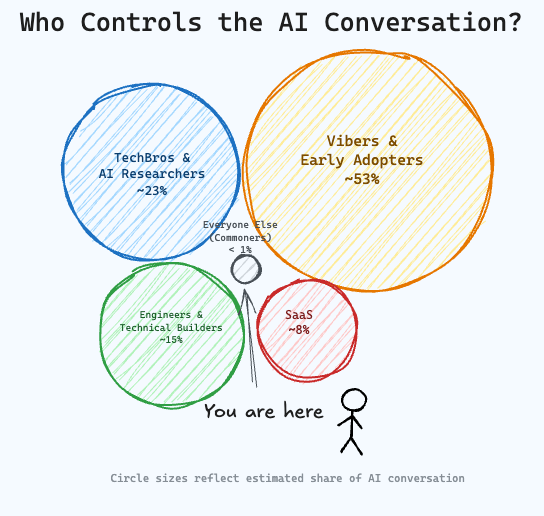
At the top are the TechBros — founders, CEOs, and VCs with access to the best data, the deepest infrastructure, and teams of researchers whose full-time job is pushing these systems forward.
Their announcements shape the news cycle.
Then come the Engineers. The machine learning specialists, data scientists, and software developers who understand how the models work at a technical level.
They debate architectures, compare benchmarks, and build things most of us will never see.
Next are the SaaS companies integrating AI into their products. They publish case studies and success stories.
SaaS case studies often read like car advertisements.
“The results were achieved in under ideal road conditions. Your results may vary.”
And then there are the Vibers. The early adopters who jumped on AI early, follow every announcement the moment it drops and create content around what they find. They are not necessarily building businesses with AI.
Many of them are just demoing what tech companies have already built.
This is my rough sense of how the conversation is divided, from following AI closely over the past couple of years. Not a study, just a pattern that I noticed.
Nearly half of everything you read about AI comes from a group whose primary activity is exploring and sharing, and not implementing in real businesses.
And the people who are actually struggling to make sense of this?
Less than 1% of the conversation.
Because nobody builds an audience by posting about confusion.
Nobody builds an audience by admitting they do not know where to start. So the people most lost in this landscape are also the quietest about it.
The Missing Voice
That missing group includes most business owners I know.
You are curious about AI, probably more than you let on, and you want to use it.
But you also have something the Vibers largely do not.
An actual business to run.
That means client calls, team problems, payroll decisions, and the hundred small fires that appear between your morning coffee and your evening review.
It means the day also belongs to chores, friends, kids and family, the actual weight of a life being lived.
Which means learning AI happens at the margins of life.
And yet you are consuming the same content as everyone else. Content made by people for whom AI exploration is the job.
The Emerging Pattern
Here is what usually happens.
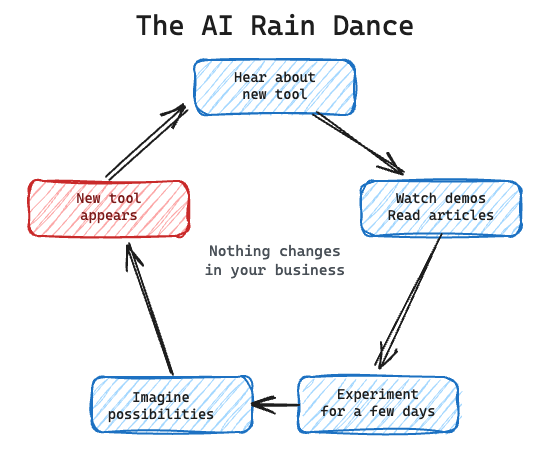
A new tool appears. It gets written up everywhere. You watch a demo, read a few takes, and maybe experiment with it for a few days. You start imagining how it might fit into your operations.
Then something new arrives before you have implemented anything.
And the process starts again.
Take OpenClaw, which has been trending heavily on Reddit, X, and everywhere else over the past few weeks. The pitch is genuinely appealing. A personal AI assistant you run on your own devices, that answers you on the channels you already use. WhatsApp, Slack, iMessage, Teams.
Always on. Fast. Local. No third-party servers sitting between you and your data.
For a business owner, that sounds like exactly the kind of tool worth exploring. Imagine your assistant handling routine WhatsApp queries from clients, or acting as a second brain you can actually query.
But when you actually look at setting it up, the tech stuff hits you.
You need to run a gateway from your terminal, configure channels, manage the control plane, and make decisions about security exposure that require a deep understanding of how these systems work.
The upside is real.
The path to get there is technical enough that a single misconfiguration can open security gaps you may not even know to look for.
So you bookmark it. You tell yourself that you will come back to it. And then the next thing appears.
Over time this becomes a cycle of perpetual exploration that feels productive but produces almost nothing concrete.
You are staying informed. You are keeping up. But six months later, your business is running exactly the same way it was before you started paying attention to AI.
This is not a motivation problem. This is not a discipline problem.
It is a pattern problem.
The AI Rain Dance
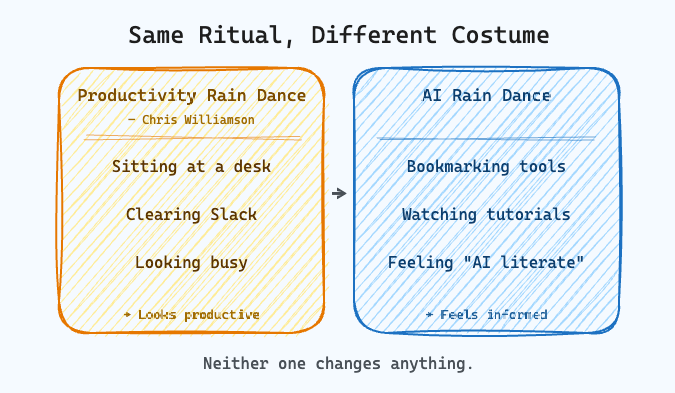
Chris Williamson talks about the “productivity rain dance”. They are the rituals people perform that resemble work without actually moving anything forward. The mind is busy, but nothing changes.
When I look at how most business owners interact with AI right now, I see the same pattern wearing a different costume.
Reading about recent developments. Bookmarking tools. Sharing articles with colleagues. Trying a few prompts. Watching demos. Each step feels like progress toward implementation.
But when the cycle repeats for months without changing how your business actually operates, it has become a ritual. A sequence of actions performed in the hope that eventually something will click.
An AI rain dance.
Why Does This Hit Harder When You Have a Business to Run?
The distraction problem affects everyone, but it compounds differently when you are responsible for outcomes — not just your own, but your team’s.
Knowledge workers can sometimes carve out focused blocks to experiment.
Business owners cannot.
Your attention is already allocated before you sit down in the morning. By the time you have space to explore a new AI tool, your mental energy is already spent. So you read instead of build. You watch instead of implement.
And underneath all of it is an anxiety that is barely spoken about in the AI conversation.
The news about job losses.
The consultants and contractors adding #OpenToWork on LinkedIn.
The quiet fear that if your competitors figure this out before you do, catching up later might not be possible.
That fear makes the rain dance feel so urgent, even when it is producing nothing.
The Shift That Ends the Dance
Most business owners approach AI by asking:
What is the next tool I should learn?
It is a reasonable question. But it is also the question that keeps the rain dance going, because there is always another tool.
A more useful question is:
What is one specific problem in my business that costs me time, money, or quality every single week?
That question changes everything. AI tools stop being trends to chase and become instruments you can actually point to something real.
The dance does not end because you finally understand AI well enough. It ends when you stop watching the sky and start digging a well.
If you find yourself caught in the cycle and want to identify exactly where AI can make a real difference in your business, I have opened up time for AI Systems Strategy Calls.
→ Book your AI Systems Strategy Call here
We will work through your specific situation, map the processes worth automating, and identify your clearest path forward.
No pressure, no obligation. Just a focused conversation to cut through the noise.