My Professor Said One Word. I've Never Forgotten It.
It sounded like an insult. It turned out to be the best AI advice.

“What does mechanical mean?”
That was the first question his mechanical engineering professor asked on the first day of class.
Answers came quickly from the room. Something about machines. Something repeatable. Something that works according to instructions.
The professor waited. Then he said, in his Bengali accent:
“Mechanical means boring.”
It took years to understand what he meant.
A pendulum clock is mechanical. Its entire job is to tell the correct time. Not sometimes. Not creatively. Not when it feels inspired.
Every second. The same way. Forever.
What Businesses Actually Need from AI
The reason that story matters is that it describes exactly what businesses need from AI.
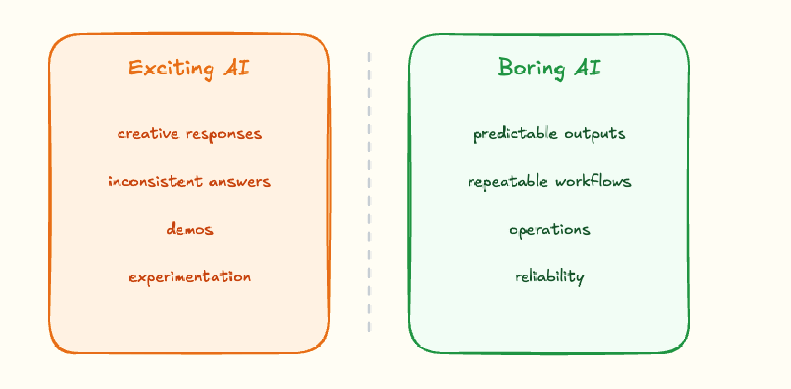
Not brilliance. Not creativity.
Reliability.
Customers come back to the same businesses because they know what to expect. Think about McDonald’s. You get the same experience across locations. The product works, the service is consistent, and that consistency creates trust.
AI is anything but consistent.
The same prompt can produce a brilliant answer, a mediocre one, or something completely wrong. That is fascinating when you are experimenting.
And terrifying when a customer is involved.
The Scope Problem
Most businesses do not fail with AI because the tools are weak.
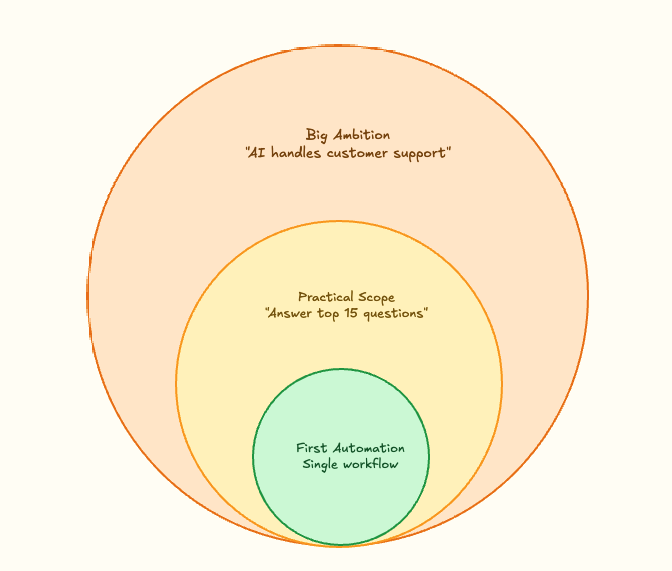
They fail because the first problem they choose is too big.
A business owner will say: “I want AI to handle our customer support.”
When what they actually need is: “I want AI to answer the fifteen questions that make up 80% of our support tickets.”
The first sounds visionary. The second is buildable in a week.
Most AI projects fail in the gap between those two ideas. Not because the technology does not work, but because the scope never made sense to begin with.
Think of AI as a brilliant new graduate. Smart, eager, and inexperienced. You would not hand them your most important client on day one. You would start small, give them one task, watch their performance, and learn their strengths and blind spots.
Trust grows from repetition, not ambition.
What This Looks Like in Practice
A trades business owner shared a problem that will sound familiar.
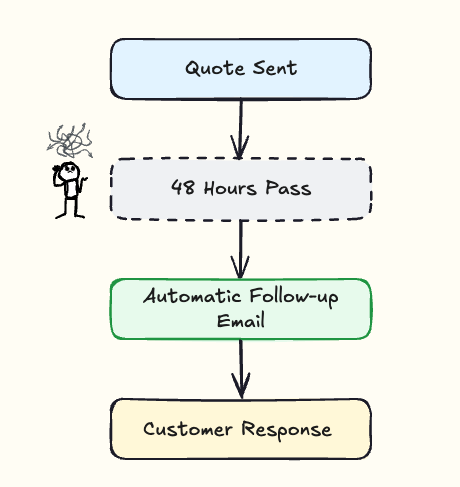
Quotes go out. Leads go quiet. Nobody follows up because everyone is busy. Qualified work is slipping through the cracks every week.
They did not build a chatbot. They did not build an AI sales agent.
They built one thing: when a quote is sent and there is no reply after 48 hours, a personalized follow-up email goes out automatically. No complex reasoning. No AI making decisions. Just a trigger, a template, and a name pulled from the job details.
That single automation recovered three jobs in the first month.
Already-qualified leads, falling through cracks simply because nobody had time to remember to follow up.
The system also did something unexpected. Once it was running, the next bottleneck became obvious. Not because anyone went looking for it, but because removing one friction point makes the next one visible.
Why Unglamorous Wins Are Real Wins
The most successful AI implementations I have seen rarely make it onto tech conference stages.
They look like this:
- Scripts that format weekly reports automatically before Monday meetings
- Automations that send proposal drafts the moment a sales form is filled out
- Invoice generation triggered when a work order is marked complete
- Lead responses that take five minutes instead of four hours
None of these is exciting to talk about. All of them run quietly every single day without anyone thinking about them.
That is the point.
Almost none of these started after someone read an article about AI transformation. They started after someone saw their own actual workflow demonstrated back to them, with one specific Monday morning problem solved and running automatically.
That is what flips the switch.
The Pattern That Keeps Businesses Stuck
When businesses get stuck with AI, it almost always comes down to the same thing.
They tried to solve the most complex problem first.
Too many steps. Too many touchpoints. Too hard to even map the full flow. When something breaks in a system like that, it breaks in front of customers.
The approach that actually works looks different:
Start with the task that makes you groan on Monday morning. Write down every single step as if you were explaining it to a new hire. Keep the scope embarrassingly narrow. Test it against real scenarios before trusting it fully.
Then watch it run for a few weeks.
The next thing to build will find you.
Making AI Mechanical
This is what the professor meant.
Mechanical systems work the same way every time. Not sometimes. Not when conditions are perfect.
Every time.
That is exactly what businesses need from AI. Not magic. Not creativity. Not surprises.
Quiet systems running in the background. Small tasks handled correctly, repeatedly. Follow-up emails going out without anyone remembering to send them. Reports formatted before the Monday meeting. Invoices generated the moment a job is marked done.
A good clock does not impress anyone. It just tells the correct time.
The professor was right.
Mechanical means boring.
And boring, in this context, is exactly what you want.
If you want to find the one specific problem in your business worth automating first, I have opened up time for AI Systems Strategy Calls.
→ Book your AI Systems Strategy Call here
We will map your actual workflows, identify where time and money are leaking, and find your clearest path to a system that runs quietly in the background — every day, without you thinking about it.
No pressure, no obligation. Just a focused conversation to get you unstuck.