Vibe Coding Feels Like Progress. It Isn't.
And the same trap is waiting for you in your business.

It was 12 PM on Monday, and I was drained.
What started as building a trading app over the weekend had bled into my work week.
The early versions worked. But now I was staring at a bug with no idea where to start. Every troubleshooting session with AI opened three new questions, and AI would egg me on for more approvals.
Eventually, I stopped reviewing and rubber-stamped everything.

Vibe coding was supposed to be easy.
Instead, it became an endless loop of next prompt, next problem, with no end in sight. Each step felt productive, but nothing felt stable enough to trust. The system kept growing, but my understanding kept shrinking.
It felt like progress. It wasn’t.
Four mistakes
I didn’t have a clear goal.
A trading app sounds specific until you sit down to build one. Then every feature is equally valid, and AI happily builds them all. Without a clear goal, every prompt becomes a guess, and AI fills the gaps with whatever seems reasonable.
When you don’t know where you’re going, AI will confidently take you somewhere else.
I didn’t define boundaries.
I never told AI what not to build. It used a different pattern each time a new feature came up, never reusing what already existed, never asking whether it should. Each decision made sense in isolation, but nothing connected to anything else.
Boundaries aren’t limitations. They’re the only thing that keeps a system coherent.
I didn’t set standards.
AI gave me three notification systems when I intended to get one.
AI gave me multiple ways of solving the same problem because I never defined what “good” looked like. The system became bigger, but not better.
The output was technically correct and completely wrong for what I needed.
I didn’t review properly.
Mental fatigue turned careful review into rubber-stamping.
I stopped collaborating and started approving, which meant AI kept building in the same direction with no correction. Once you stop steering, the work drifts, and the longer you wait to course-correct, the more overwhelming it gets.
Approving without understanding isn’t reviewing. It’s just hoping.
These aren’t coding mistakes. They are the same four mistakes anyone makes the first time they try to use AI in their business.
The principle: Begin with the end in mind
The fix wasn’t a better tool.
It was clarity before action. Knowing what success looks like before asking AI to generate anything. Being specific enough that you can recognise whether the output is right or wrong.
Everything changes when the destination is clear.
Imagine you are sending a proposal to a client.
You ask AI to draft it, and it produces something that sounds polished. But something feels off, and you end up rewriting more than you expected. Not because AI failed, but because the target was never clearly defined.
AI can only execute what you make explicit.
This is the simplest way I’ve found to think about it.
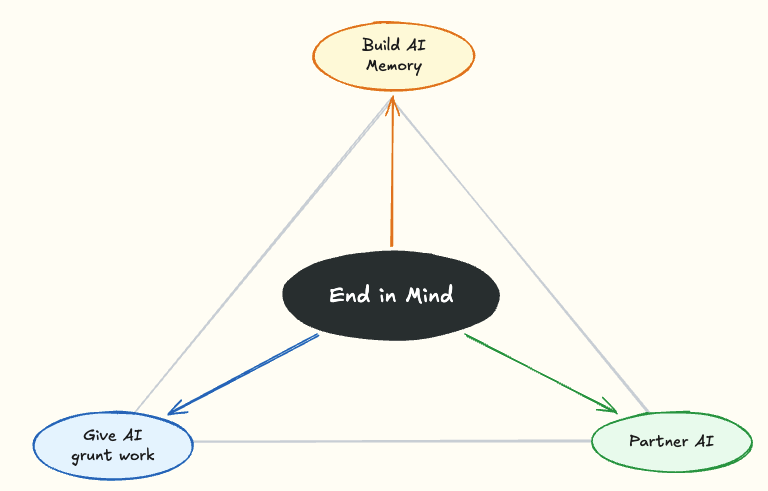
Everything starts with clarity. Once you know what “good” looks like, there are three ways AI can become useful in your business. Not more tools. Not more prompts.
Just three ways to apply it.
- Build AI Memory
- Give AI grunt work
- Partner AI
Approach 1: Build AI memory
AI starts from zero every time you open a new chat.
It doesn’t know your business, your clients, or what has worked for you before. So it guesses, and those guesses are often generic and inconsistent. That’s why outputs feel different every time.
Consistency starts with context.
Take that same proposal example.
Instead of opening a chat and typing away, create a project in Claude or ChatGPT and load it with your past proposals, the ones that won, the tone that worked, and the structure your clients respond to. Add your guardrails. No jargon, no fluff, clear structure, and familiar language.
Now every draft builds on what already works instead of starting from zero.
That’s the difference context makes.
But memory only helps with the work you are actively doing. Some of your biggest time drains come from the grunt work you have to do. That is where the second approach comes in.
Approach 2: Give AI grunt work
Some of your biggest leaks happen after the work is done.
A proposal goes out, and nothing happens. Follow-ups get delayed, forgotten, or skipped because everyone is busy. Opportunities quietly fall through the cracks.
AI works best when it removes this kind of friction.
Imagine a client receives your proposal.
They intend to reply, but the week gets busy. The email gets buried, and no one follows up. What should have been a simple “yes” turns into silence.
Lost work rarely feels like a mistake.
Now add one simple automation.
If there is no reply after 48 hours, a follow-up goes out automatically. If there is still no response, a reminder nudges them to take the next step. No one has to remember, no one has to follow up.
The best follow-up is the one that happens without you having to think about it.
Memory keeps AI informed. Automation keeps your business moving.
But the biggest wins come when you and AI work together on the same problem, each doing what the other cannot.
Approach 3: Partner AI
The biggest gains don’t come from handing work to AI.
They come from working with it. You bring context, judgement, and experience. AI brings speed, structure, and consistency.
The result is better than either could produce alone.
Take that same proposal.
You enter the client name, the scope, and the key details. AI assembles the slides using your pricing, your terms, and your past work. You review the wording, change what only you can judge, and ask AI to tighten what remains.
Neither of you could have done that alone.
This is co-creation.
The notepad still wins
After the trading app disaster, my next project was to build an automated essay-grading system for a client. This time, I started differently.
I picked up a notepad.
I wrote down the requirements, the steps, and what success looked like. Then I used AI to help execute each part, one step at a time. The thinking stayed with me. The execution moved to AI.
That made all the difference.
Because this time, the system had direction before it had speed.
AI is only as good as the thinking you bring to it.
Give it chaos, and it builds you more chaos.
Give it clarity, and it builds you something you can trust.
That is the difference between vibe coding and building a system.
If you want to find the one specific problem in your business worth automating first, I have opened up time for AI Systems Strategy Calls.
→ Book your AI Systems Strategy Call here
We will map your actual workflows, identify where time and money are leaking, and find your clearest path to a system that runs quietly in the background — every day, without you thinking about it.
No pressure, no obligation. Just a focused conversation to get you unstuck.