AI Didn't Fix the Problem. It Hid It.
How AI amplifies complexity while making it look solved
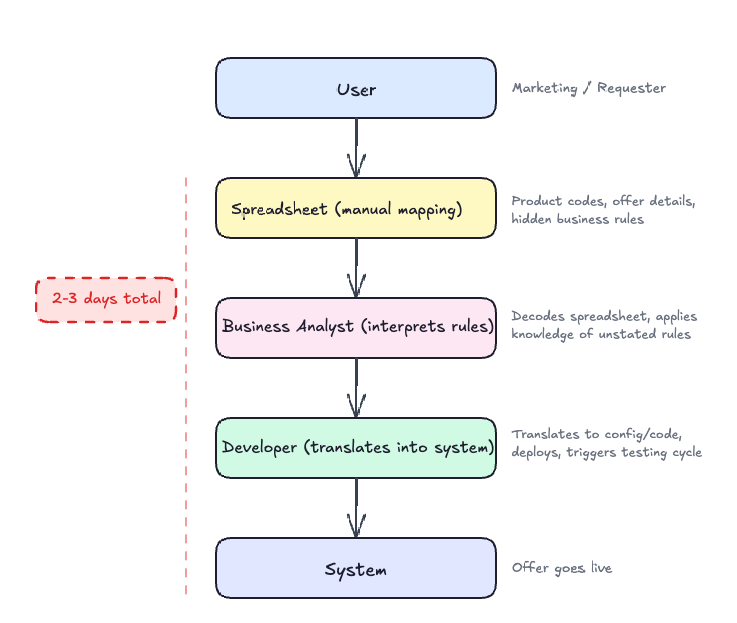
“We are launching three offers.”
I saw the business analyst roll her eyes the moment the product team said that. Not because it was complex.
But because she could already see what was about to happen.
A few hours would disappear into a spreadsheet she doesn’t fully trust.
Looking up product codes in the database.
Mapping them to offer values.
Running scenario after scenario to make sure nothing breaks.
This work was not what she was hired for. But the process did not care.
The system had pushed its complexity onto people.
And when she handed it to the developer, the frustration took a different shape.
Now the work was repetitive.
Unforgiving.
And risky.
Because one mistake could put the wrong offer live in front of customers. And no one would catch it immediately.
And that is the point where these workflows become dangerous.
People are looking for AI to rescue them from this very workflow.
And it looks like an AI problem.
It isn’t.
It’s a system design problem.
Why AI looks like the obvious answer
Most businesses are full of repetitive, mind-numbing work that people are desperate to escape.
Not just because it is tedious. But it sits in an uncomfortable space of high effort and low perceived value, yet carries real consequences if done incorrectly. That combination makes these workflows feel heavier than they should.
So when AI shows up, it does not just look useful.
Slick demos, nonstop AI hype, and easy access to powerful tools create a very specific kind of expectation. You describe a task. The system produces a result. Clean, fast, contained.
For a business owner or an operations leader already overwhelmed by the day-to-day, that interaction feels less like assistance and more like relief.
And that feeling is important.
Because the result appears instantly in a chat window that feels conversational and effortless. It becomes easy to believe that the tool is not just helping with the work but entirely replacing the need to think about it.
The problem starts to feel less like something to design… and more like something to generate.
And that is why the AI answer feels so obvious.
One agent. No spreadsheets. No handoffs. Sounds perfect, right?
On paper, the answer looks brilliant.
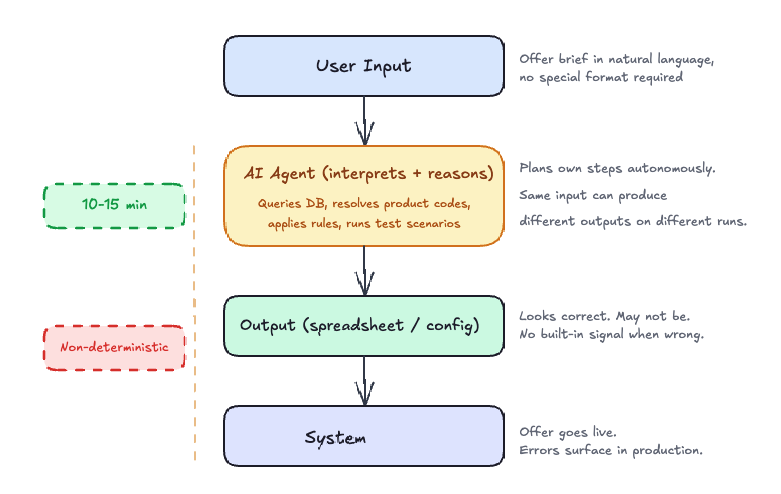
Give an AI agent the offer brief, access to the product database, the spreadsheet template, and the business rules.
The agent reads the brief.
Resolves the product codes.
Applies the rules.
Builds the spreadsheet.
Checks for conflicts.
Prepares the output for deployment.
What used to feel like a slow, frustrating chain of handoffs starts looking like one clean, automated flow.
If you are sitting inside the business, that promise is very hard to ignore.
And the appeal goes beyond speed.
The agent works with unstructured language, rather than forcing the team to translate everything into rigid inputs first. It can query multiple systems without requiring someone to manually jump between spreadsheets, databases, and documentation. It turns what used to require coordination and context into something that feels like a single interaction.
The work does not just become faster.
It feels simpler.
And that is where it becomes compelling.
Because it no longer looks like you are improving the process. It looks like you are removing the need for the process altogether.
That is the point where many business owners believe they have solved the problem.
But those slick demos are hiding something.
An impressive output is not the same thing as a reliable system.
The same agent can produce different results from the same brief on different runs — not because it is broken, but because it is re-reasoning through the task each time instead of following a fixed, deterministic path, which makes the failure dangerous.
A product code can be wrong. A rule can be interpreted slightly differently. An edge case can be missed.
And the spreadsheet still looks clean, structured, and complete enough to pass a casual review.
That’s the dangerous part.
The error isn’t caught in the process. It shows up later, after it has already hit customers, revenue, or downstream systems.
That makes agentic AI dangerous in this class of workflows.
There is also a structural cost hidden behind the flexibility.
Every run forces the model to reprocess the context, re-read the rules, and re-reason through the task from scratch. It never builds on logic already encoded into the system. So as the product catalogue expands and exceptions pile up, two things grow in tandem: the cost of each run and the risk of getting it wrong.
That is a poor trade when the business really needs repeatability.
What was the actual problem?
To understand the problem, you cannot begin with technology. The thinking should begin with the user journey.
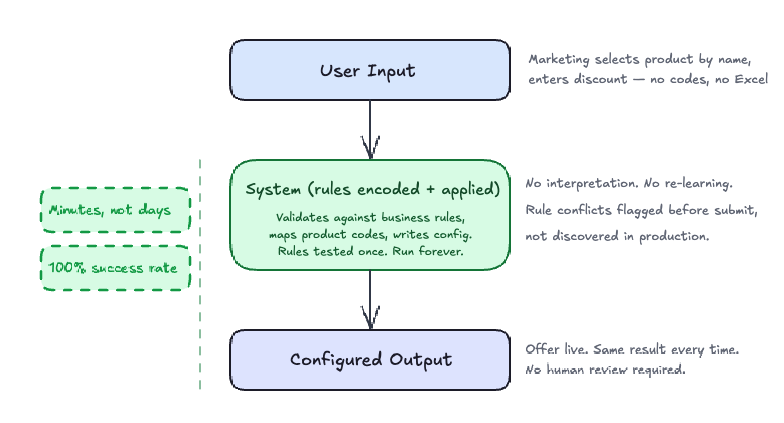
From the user’s perspective, the desired flow is simple. Choose the products, enter the offer details, and submit the request. That’s it. No product codes to look up. No hidden logic to second-guess. No need to think about how internal systems coordinate behind the scenes.
Once you step back and look at it this way, the real problem becomes easier to see.
This is not primarily a problem of intelligence. It is a problem of workflow design.
The friction comes from forcing humans to carry technical complexity that the system should have absorbed. That’s why the spreadsheet exists as a translation layer. Manual handoffs serve as a coordination between disconnected steps. And why a developer is required: the spreadsheet itself cannot actually configure the underlying system.
That is the gap.
The system has not internalised its own logic, so the logic leaks outward into people, tools, and workarounds.
And once you see that, the nature of the solution changes completely.
The fix isn’t smarter AI, it’s a better system
Once you have framed the problem, the requirements become straightforward.
The business needs a way for someone to define an offer without having to deal with internal representations. That means a controlled interface that captures intent without exposing product codes, mappings, or constraints buried in the underlying system.
It needs a system that takes that input and applies the business rules consistently — not by interpreting them each time, but by encoding them into a deterministic flow that produces the same result for the same conditions.
And it needs that flow to integrate directly with the underlying systems so that the output is not an intermediate artifact like a spreadsheet, but the actual configuration of the offer itself.
The logic that currently lives in spreadsheets, handoffs, and people needs to be internalised into the system.
That is the shift.
The best system is the one that does not require anyone to think about it twice. It just works.
And once you see that, the solution no longer looks like an intelligent agent.
It looks like a repeatable, automated workflow.
When the demo wins, the system loses
Smart businesses still get this wrong because the market makes the wrong answer look obvious.
AI hype is omnipresent. Teams are exposed to demos that collapse complexity into a clean interaction, and influenced by a broader narrative that frames AI adoption itself as a competitive advantage.
The signal they receive is not to redesign workflows, but to move faster using better tools. And because the output looks correct, the underlying complexity is no longer questioned.
That is where the problem begins.
Most business owners and operations leaders lack the technical depth to distinguish a compelling interaction from a well-designed system.
The other challenge is that teams lack people who can think in system design while also understanding where AI fits within that system.
So the evaluation becomes biased toward what looks impressive instead of what behaves reliably.
Believable demos win, even when they are solving the wrong problem.
And that is why this mistake is so common.
The real challenge is not whether AI can produce an output, but whether the problem is being framed correctly.
And that is the trade most businesses don’t realise they are making.
Conclusion
Some problems need AI. Others need better software.
This offer workflow looks like an AI opportunity only because the current process is so painful that any escape route feels compelling. But once you reframe the problem, the answer becomes simpler. The business does not need a model to think through the mess.
It needs a system that stops forcing people to deal with the mess at all.
The question is not whether AI can do the task.
The question is whether the task should have needed AI in the first place.
The next time you see an AI solution that looks impressive, pause for a moment. Ask yourself:
Is this actually solving the problem? Or just making it easier to live with a broken process?
If you want to find the one specific problem in your business worth automating first, I have opened up time for AI Systems Strategy Calls.
→ Book your AI Systems Strategy Call here
We will map your actual workflows, identify where time and money are leaking, and find your clearest path to a system that runs quietly in the background — every day, without you thinking about it.
No pressure, no obligation. Just a focused conversation to get you unstuck.