The Problem Isn't AI Adoption. It's AI Fragmentation.
Why your team using AI differently is making your business less consistent and not more efficient

A few days ago, I watched a delivery head demo his AI workflow.
He had built an agent connected to Jira. If someone moved a ticket to “In Progress” without sufficient detail, the agent would push it back to “To Do.”
He walked through the demo step by step. Clearly proud of what he had built.
The outcome?
A basic checklist.
Nobody said anything. But you could feel it.
It didn’t matter.
His team wouldn’t use it. The organisation wouldn’t feel it. And yet, he had invested time building it. And he was genuinely proud.
That moment stayed with me.
Because I see the same pattern in almost every business.
Different tools. Different workflows. People convinced they’re getting ahead with AI.
The output is almost always the same.
Impressive to the person who built it.
Invisible to the organisation.
If that feels familiar, it’s not because AI isn’t working. It’s because AI is solving the wrong problems. He built something that worked for something that didn’t matter.
That’s why it doesn’t change the business.
The problem hiding in plain sight
Everyone is using AI.
And everyone is using it differently.
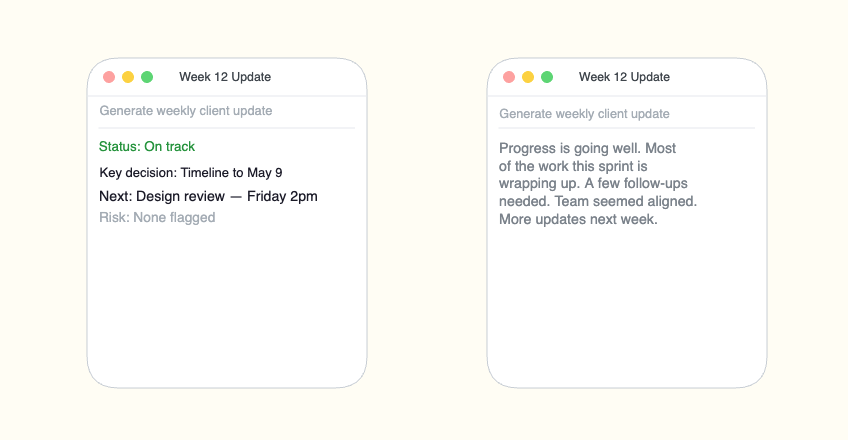
Two salespeople. Same lead. Different prompts. Different tone. Different next step. The lead doesn’t know which version of your business they got.
But they felt the difference.
That’s not an AI problem. That’s a consistency problem AI just made visible.
The business is not more consistent.
It is more efficient at being inconsistent.
AI doesn’t standardise work.
It amplifies whatever is already there.
Individual AI use feels like progress.
But the business itself is not improving.
The shift that actually moves a business forward.
Stop letting people use AI however they want. Start building it into the way work gets done.
When a person uses AI, the result depends on that person.
Their prompt. Their judgment. Their energy level that day.
When AI is built into a process, the result is consistent, regardless of who runs it.
Most businesses are still operating at the “individual effort” stage.
The ones pulling ahead are building workflows.
Here’s what that looks like in practice.
A gym had an enquiry form on its website.
Here is how their team handles it now: when someone fills the form, an AI agent follows up immediately. A personalised message based on what the lead entered, with one clear next step:
- book a fifteen-minute call.
- The calendar is attached.
- The lead picks a time.
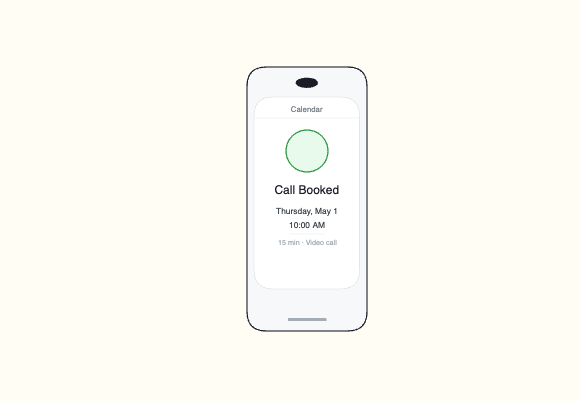
By the time anyone on the team sees the lead in the CRM, the agent has booked the call, and the sales team only needs to show up.
That was not always how it worked.
People would fill out the form and leave their details. And then someone would eventually get to it. Maybe that day. Sometimes, two days later, when the week got busy. By then, the lead had moved on. Not because they were not interested. Because the moment had passed.
When someone fills out an enquiry form, they are at peak intent. No team can reliably do that manually. People are in meetings, on-site, handling the work that pays the bills.
The workflow catches what people miss. Every time.
The salesperson does not need to chase. The lead does not go cold. And every lead gets the same fast, professional response, regardless of the day or the team’s workload.
That is the shift.
One person using AI to draft a follow-up email is individual productivity. A workflow that catches every lead at the moment they are most open to act is organisational progress.
Making this practical
Most teams try to solve this by aligning on tools.
It rarely sticks.
Because alignment fails when it starts with tools instead of outputs. When everyone knows what “good” looks like and how to produce it, adoption follows naturally. Not because someone enforced it, but because it makes the work easier.
If you want to apply this, start here:
Pick one workflow that your team runs differently every time. Write what the output should look like: every component, every time. Then ask: where in this workflow does a person have to remember something? That’s where AI goes.
Not around the work. Inside it.
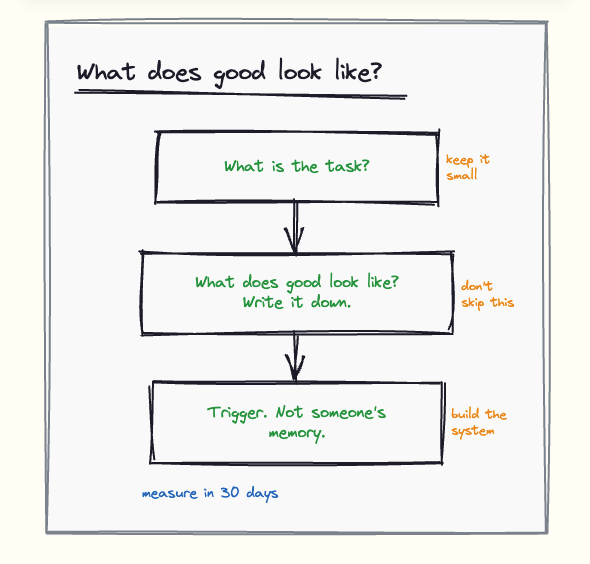
One hour to define it. Every future run costs nothing extra.
You don’t need a complex setup to start. A shared document. A well-written prompt. A clear definition of the output.
That’s enough.
And yes, this might feel like time you don’t have.
But you’re already paying for it. Every week in rework, delays, and re-explaining what you meant. The hour you spend defining what “good” looks like pays back every time someone runs the workflow without asking.
Most teams don’t fail at AI because they lack tools.
They fail because nobody has defined what good looks like.
The point worth remembering
AI does not fix messy businesses. It scales them.
The businesses that look like they figured out AI a year from now will not be the ones where everyone had the most advanced personal prompts. They will be the ones where someone sat down, wrote out what good work actually looked like, and built AI into the process instead of leaving it to individual habit.
You do not need a better tool.
You need one better workflow.
Start there.
If you want to find the one specific problem in your business worth automating first, I have opened up time for AI Systems Strategy Calls.
→ Book your AI Systems Strategy Call here
We will map your actual workflows, identify where time and money are leaking, and find your clearest path to a system that runs quietly in the background — every day, without you thinking about it.
No pressure, no obligation. Just a focused conversation to get you unstuck.